
Bounce House Safety Rules: Setup, Supervision and Water
Bounce house safety rules from CPSC, Nationwide Children's Hospital and the makers' manuals: setup, wind, supervision, age and size mixing, slides and water.
Affiliate disclosure: product links on this page go to Amazon, or to the maker's own store for brands that sell only direct. As an Amazon Associate we earn from qualifying purchases, at no extra cost to you; a link to a maker's store earns us nothing. No retailer or brand sees our picks before they are published or has any say in them. How we choose.
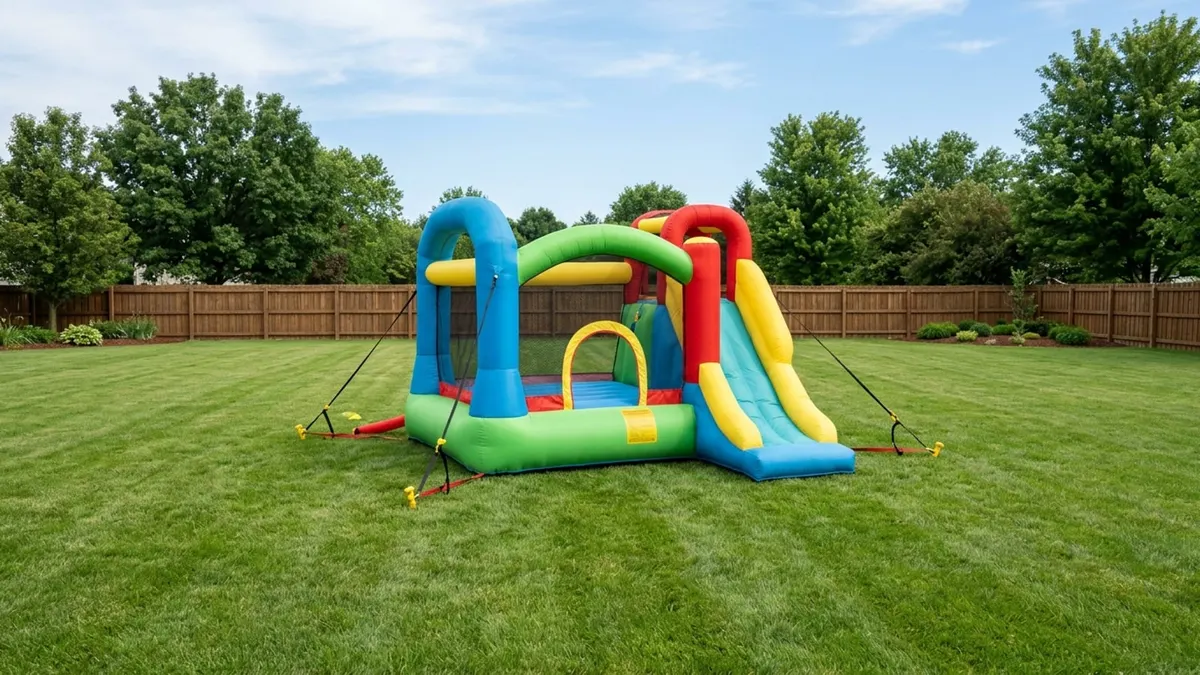
The short version: set the bounce house on level grass with 2 m (6.6 ft) of open space around it, stake every loop, plug the blower into a GFCI outlet, check the wind against your manual's limit, and keep an adult watching the whole time with only the number of kids the maker allows, all about the same size. Every manual we read says the same things, and CPSC and Nationwide Children's Hospital add the rest.
Why the rules matter
CPSC estimated more than 18,000 bounce house injuries treated in hospital emergency departments in 2018, and says 12 deaths involving inflatables were reported to it from 2003 to 2013. Nationwide Children's Hospital's Center for Injury Research and Policy puts bouncer injuries at more than 30 children a day, about one every 45 minutes, including broken bones and concussions. The home-use inflatable standard, ASTM F2729, is written for children aged 2 through 12.
Before anyone gets in
The spot
- Level, soft ground. Little Tikes says level ground with firm grass or soil; Bounceland says a soft, level surface and never a slope. Little Tikes and Bounceland both rule out concrete and asphalt for their residential bouncers.
- Clear the ground. Nationwide Children's Hospital says to remove rocks, sticks and anything sticking up, such as sprinkler heads.
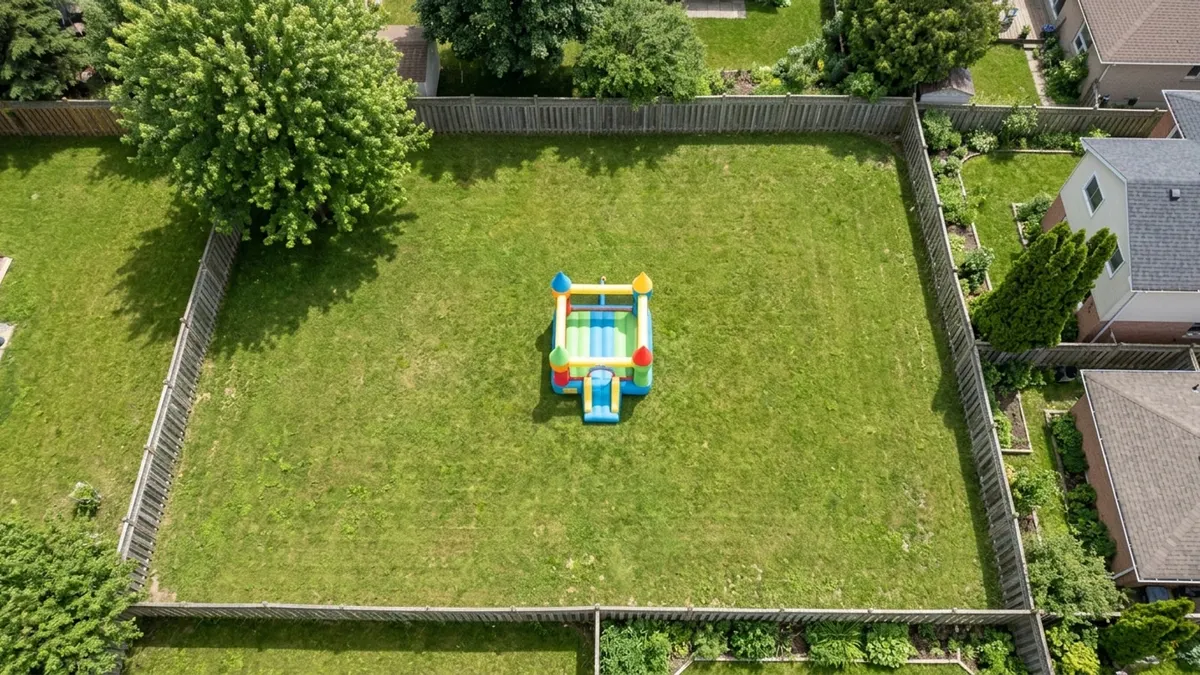
- Clearance. Little Tikes asks for 6.6 ft (2 m) in every direction, overhead included; Bounceland at least 2 m from fences, buildings, branches, washing lines and wires. CPSC says never near tree branches, power lines or fences. Water slides need more: Banzai's Speed Slide manual asks for 10 ft. Measure your lawn against that with the yard space calculator.
Anchoring and wind
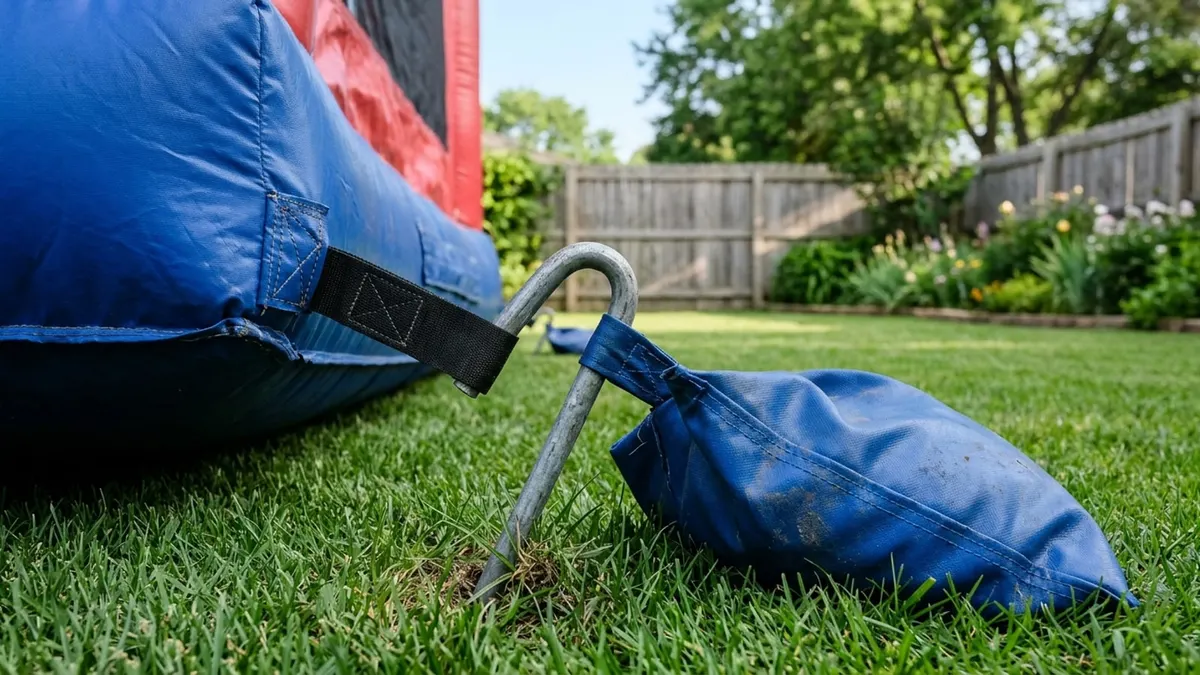
- Stake every loop, straight down and below ground (Little Tikes). See our anchors and sandbags guide.
- Check the wind against the manual: Little Tikes 20 mph, Bounceland 25 mph. CPSC says no more than 15 to 25 mph. No use in rain or lightning (Bounceland).
Power
- GFCI outlet or GFCI plug, every time.
- Little Tikes says no extension cords with its bouncers.
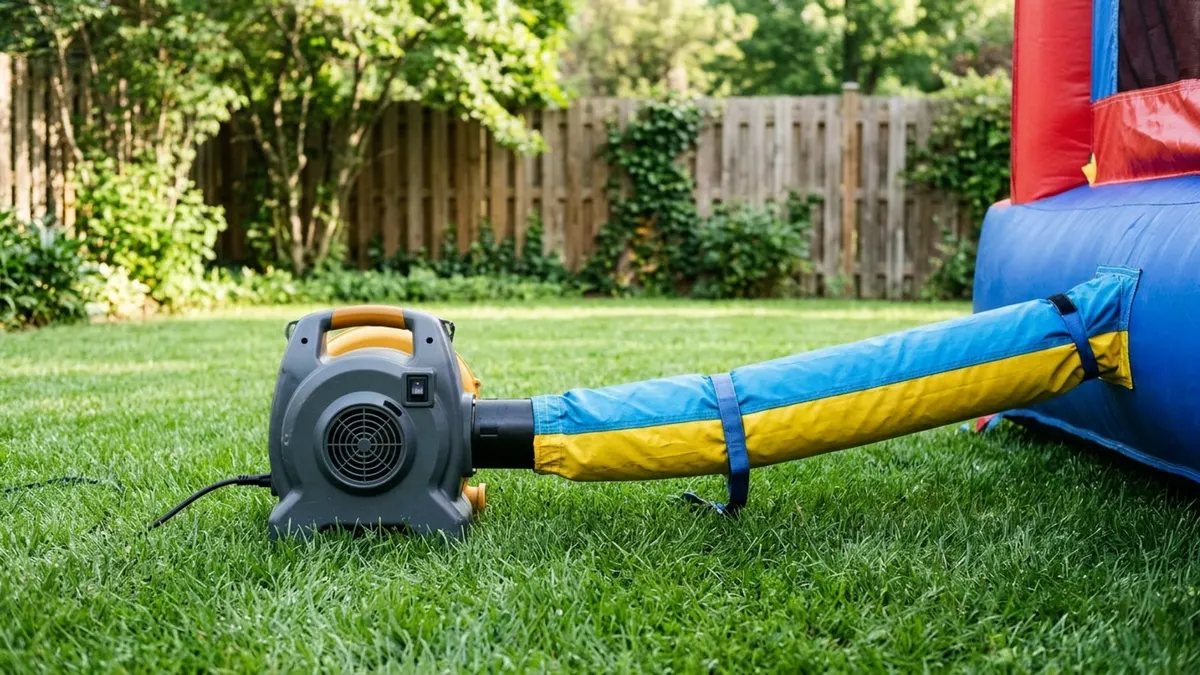
- Use only the supplied blower or the maker's specified replacement (Little Tikes, Bounceland). No speed controls.
- Keep the blower and cord away from water and walkways, and keep kids away from the blower. CPSC adds: keep children away from generators and air pumps, especially near standing water.
Inflate fully first
Little Tikes and Bounceland say no one goes in until the unit is fully inflated, and the blower runs the whole time anyone is inside. Air escaping at the seams is normal; Little Tikes says not to try to seal it.
While kids are inside
Supervision
Every manual says an adult watches the whole time. Little Tikes specifies constant, competent adult supervision from in front of the device, where all parts of the play area can be seen. Nationwide Children's Hospital says only use a bouncer when an adult trained on safe bouncer use is present.
How many, and who
- Never more than the maker's number. For example, 2 on the Little Tikes Jr. Jump 'n Slide and 3 on the Jump 'n Double Slide.
- Same size together. CPSC says only children about the same age and size should jump at one time; Little Tikes and Bounceland say the same. Nationwide Children's Hospital says the safest way is one child at a time.
- Age. Makers rate units from age 1 to 3 and up; Nationwide Children's Hospital suggests limiting bouncer use to children 6 and older. Bounceland's manual also bars pregnant women, small infants, and anyone with head, neck or back injuries.
- Weight. Hold to both the total and the per-child limit. See our bounce house guide for how those differ by model.
House rules
- No shoes, glasses, jewelry or sharp objects in pockets (Nationwide Children's Hospital, Little Tikes, Bounceland).
- No loose clothing, scarves, hoods or drawstrings (Little Tikes).
- No flips, wrestling or rough play (CPSC, every manual).
- No food, drink or gum inside (Little Tikes, Bounceland).
- Stay away from the entrance and the walls; no climbing or hanging on walls or netting (Nationwide Children's Hospital, Little Tikes, Bounceland).
- Nothing tied to the bouncer: no jump ropes, leashes or cords, which Little Tikes and Bounceland flag as a strangulation hazard.
- Keep pets out.
Slides
Feet first only, one child at a time, never standing on the slide or rails, never jumping off, and a clear landing before the next child goes (Little Tikes, Bounceland, Banzai). Bounceland and Banzai both say not to slide facing direct sunlight. More in our bounce houses with slides guide.
If it starts to deflate
Stop play and get everyone out carefully (Nationwide Children's Hospital, Bounceland). Then check the blower connection, the outlet and the GFCI.
Water slides and splash pools
Wet units bring a drowning risk that dry bouncers do not. Banzai's Speed Slide manual says drowning can happen silently in as little as 2 in of water, that children as young as 2 have climbed in and drowned, and that after use you should remove water to 1/2 in or less and empty the unit or block access when not in use. It also asks for at least 8 in of water in the pool before anyone slides. Never leave a wet unit unattended, even for a minute. Our water slide guide covers model-by-model limits.
After play
- Everyone out before the blower goes off.
- Bounceland says do not leave the bouncer inflated overnight; Banzai says never leave the blower outside overnight.
- Dry it completely before rolling it up; every manual says never store it wet (care and storage steps).
Printable checklist
- Level grass, cleared, 6.6 ft clear on every side and overhead.
- Every loop staked; blower staked; GFCI; no extension cord unless your manual allows it.
- Wind under the manual's limit; no rain or lightning.
- Fully inflated before anyone enters.
- Adult watching from the front the whole time.
- Maker's kid count, weight limits, similar sizes.
- Shoes, glasses, jewelry and sharp objects off; no food or gum.
- No flips, wrestling, climbing walls; feet first on slides.
- Losing air: everyone out.
- Water units: empty after use, never unattended.
Frequently asked questions
Are bounce houses safe for toddlers?
Makers rate some units from age 1 or 2, but Nationwide Children's Hospital's injury researchers suggest limiting bouncer use to children 6 and older and say one child at a time is safest. If toddlers use one, keep them apart from bigger kids and keep an adult at the entrance.
How many kids should be in a bounce house at once?
Never more than the maker's number, which ranges from 2 on small bouncers to 5 or more on party units. CPSC says only kids of about the same age and size should jump together, and Nationwide Children's Hospital says one at a time is safest.
Can you use a bounce house in the wind?
Only below the manual's limit: 20 mph for Little Tikes and 25 mph for Bounceland. CPSC says maximum wind speed should be no more than 15 to 25 mph. If gusts pick up, get everyone out first.
What surface should a bounce house be on?
Level, soft ground such as grass, cleared of rocks, sticks and sprinkler heads. Little Tikes and Bounceland rule out concrete and asphalt for their residential bouncers. Nationwide Children's Hospital says put a soft surface at the entrance if the ground around it is hard.
How many bounce house injuries happen each year?
CPSC estimated more than 18,000 bounce house injuries treated in emergency departments in 2018. Nationwide Children's Hospital says bouncer injuries now equal more than 30 children a day.
Can you leave a bounce house up overnight?
Bounceland says not to leave its bouncers inflated overnight, and Banzai says never to leave the blower outside overnight. Deflate after play, dry it, and store it indoors.
Sources
- Don't Get Swept Away: CPSC Reminds Consumers to Be Grounded in Safety When Using Bounce Houses, U.S. Consumer Product Safety Commission
- Inflatable Bouncer Safety, Nationwide Children's Hospital, Center for Injury Research and Policy
- ASTM F2729-24 Standard Consumer Safety Specification for Constant Air Inflatable Play Devices for Home Use, ASTM International
- Jr. Jump 'n Slide Bouncer: Instructions for Installation and Operation (637995), Little Tikes
- White Jump 'n Double Slide Bouncer: Instructions (666209), Little Tikes
- Bounceland Owner's Manual and Safety Guidelines, Bounceland
- Speed Slide Water Park: Instructions, Banzai
Cover image: Illustration: Backyard Inflatable Review (AI-generated)
Related guides
Best Bounce House Blowers: Replacement and Commercial (2026)
Five inflatable blowers from 5.5 to 11.5 amps, and why the horsepower on the box is the least useful number on it.
Bounce House Anchors: Stakes, Sandbags and Wind Limits
Stakes, sandbags and tarps for bounce houses and water slides, and the wind speeds at which Little Tikes, Bounceland and CPSC say to stop.
Bounce House Size Calculator: Will It Fit Your Yard?
Enter a bounce house (or pick one) and your lawn, and see the space it really needs once the makers' clearance zone is added.