
Bounce House Anchors: Stakes, Sandbags and Wind Limits
How to anchor a bounce house or water slide: stakes on grass, sandbags on hard ground, how deep, how heavy, and every maker's wind limit, from the manuals.
Affiliate disclosure: product links on this page go to Amazon, or to the maker's own store for brands that sell only direct. As an Amazon Associate we earn from qualifying purchases, at no extra cost to you; a link to a maker's store earns us nothing. No retailer or brand sees our picks before they are published or has any say in them. How we choose.
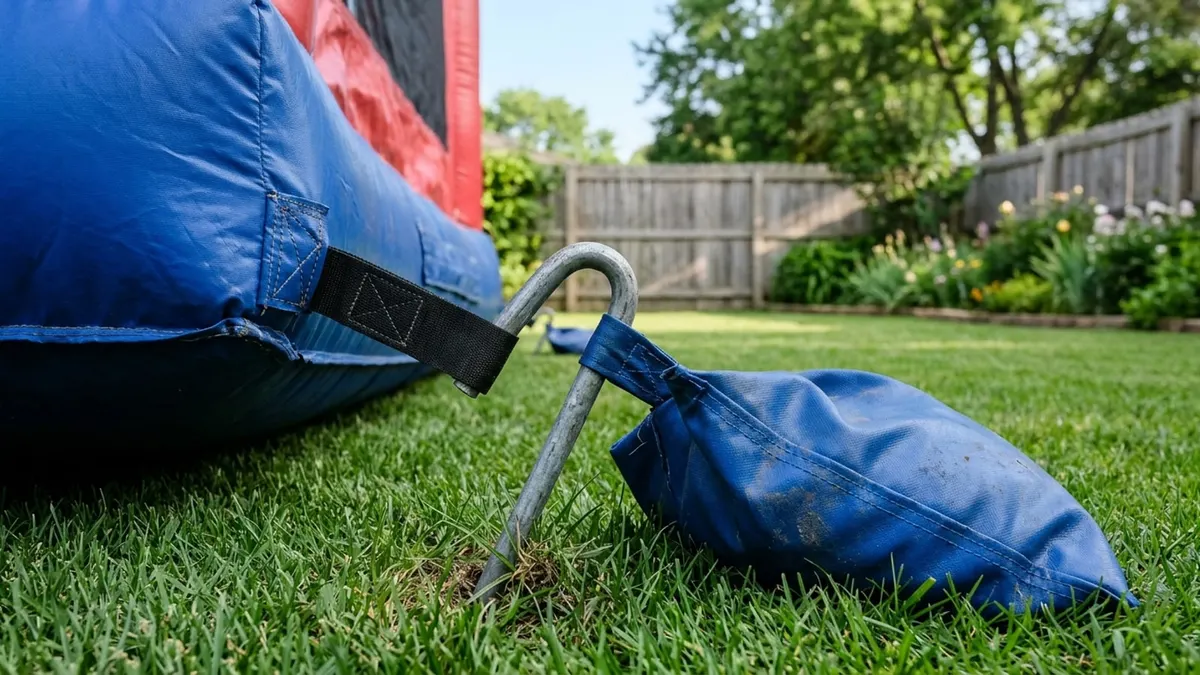
On grass, anchor a bounce house with every stake loop and the stakes the maker supplies, driven straight down until the tops are below ground. Sandbags are for hard surfaces, and most residential bouncers are not allowed on hard surfaces at all: Little Tikes says never on concrete, asphalt, wood or packed earth, and Bounceland says not over concrete, asphalt or any hard surface. Whatever you anchor with, stop when the wind passes the maker's limit.
Why anchoring matters
CPSC's 2019 warning on bounce houses was titled "Don't Get Swept Away". It says a bounce house must be "properly staked and anchored on a flat, even surface" and that maximum wind speed should be no more than 15 to 25 mph. Bounceland's manual puts the risk plainly: sudden gusts of wind may lift the product off the ground.
Stakes on grass
Use every loop
Little Tikes ships its Jr. Jump 'n Slide with 8 bouncer stakes and 4 blower stakes, and says the bouncer must be anchored using stakes. Bounceland says to hook a stake through each loop. A loop left empty is a corner that can lift.
Straight down, below ground
Little Tikes' current manuals say to drive stakes straight down until the top is below ground level, and not at an angle. That also removes a trip hazard. Bounceland says to drive them deep and keep the hooked end over the loop the whole time the bouncer is in use. Commercial units go further: the Bouncing Angels manual for its 13 by 13 ft vinyl bouncers says to drive stakes at least 15 in into the ground.
Soil matters
Little Tikes notes that stakes hold best in hard, dry soil, and that loose or wet soil, or both, reduces their holding strength. After rain, check every stake before kids go in, and check again during play: Bounceland asks you to check stakes at regular intervals.
Lost the originals? Ask the maker for replacements first: Banzai's water park manual says to use manufacturer-supplied stakes only. If your maker sells none and your manual does not rule out substitutes, galvanized J-hook stakes like these 12 in rebar stakes are longer than the 9 in stakes Bounceland lists and the 10 in stakes YARD lists for their units.
Before you drive a stake
Bounce house stakes go in 9 to 15 in deep, and lawns can hide sprinkler lines and low-voltage lighting cable as well as utility lines. The national 811 service says every digging project, regardless of depth, requires contacting 811 a few business days in advance, including small jobs like planting shrubs or installing a mailbox, and the request is free. If you do not know where your lines run, put in an 811 request before the first party, then use the same spot each time. Banzai's water park manual adds a quicker check for every setup: look under and around the inflatable for rocks, sticks and lawn sprinklers before you unroll it.
Sandbags on hard surfaces
Sandbags replace stakes where a stake cannot go: a driveway, a patio, a parking lot or a gym floor. The Bouncing Angels commercial manual says to substitute sandbags for stakes on hard surfaces. But check your manual first. Little Tikes and Bounceland residential bouncers should not be on hard surfaces at all, because falls onto hard ground cause head and other injuries; Little Tikes adds that carpet over floors may not prevent injury.
Indoors is different again. Bounceland says its indoor-rated bouncers need no stakes or sandbags indoors. Some adult units ship with sandbags and wind ropes in the box, such as HXDOGSP's 13 ft vinyl bouncer.
How heavy? The Bouncing Angels manual is the only one we read that gives a figure. It asks for four sandbags, one at each corner, at 60 lb each for its 11 by 11 and 13 by 13 ft bouncers, and 80 lb each for its 13 by 13 ft A-frame and arched-roof models and all of its 15 by 15 ft models. A bag that holds 50 lb falls short of the 60 lb mark, so use two bags per corner or a larger bag, and follow your own manual's figure where it gives one.
Vinyl sandbags with handles and hook straps are the usual kind. These hold up to 50 lb of sand each and ship empty:
Magic Jump's Hullaballoo bags are a heavier, rental-industry option: Hullaballoo vinyl sand bags.
A tarp underneath
The Bouncing Angels manual says to always set the unit up on top of the provided tarp, after checking the area for sharp objects. Residential makers ask for the same ground check (Bounceland: check for sharp objects and debris) without requiring a tarp. A plain ground tarp keeps the floor cleaner and drier; make sure it does not extend past the unit as a slip or trip edge.
Wind limits by maker
| Source | Wind limit | Applies to |
|---|---|---|
| CPSC | No more than 15 to 25 mph | Bounce houses generally |
| Little Tikes | Do not use above 20 mph | Jr. Jump 'n Slide, Jump 'n Double Slide |
| Bounceland | Do not use above 40 km/h (25 mph) | All Bounceland bouncers |
| Bouncing Angels | Do not set up above 15 mph | 13 x 13 ft commercial bouncers |
Wind limits are for steady wind and gusts. If gusts pick up mid-party, get everyone out first, then turn the blower off; Bounceland's manual says the bouncer must stay fully inflated until everyone is out.
Reading the forecast against the limit
Forecast words map onto these numbers. The National Weather Service uses "breezy" for sustained wind of 15 to 25 mph, "windy" for 20 to 30 mph and "very windy" for 30 to 40 mph. A breezy forecast already sits inside CPSC's 15 to 25 mph ceiling and above the Bouncing Angels 15 mph limit, and a windy forecast is past Little Tikes' 20 mph. Check the hourly forecast for the party window, not just the daily summary, and look at gusts as well as the steady speed.
Water slides and wet ground
Inflatable water slides anchor the same way, but the ground under them gets soaked, and Little Tikes notes that wet soil reduces a stake's holding strength. Banzai's water park manual says to anchor every loop to turf, sand soil or rock soil with the stakes provided, drive them completely in so no part sticks up, and check them occasionally to make sure they stay secure. It also keeps the power away from the water: blowers and cords must not pass under the inflatable and should sit at least 4.3 ft (1.3 m) from a walled side and 8.2 ft (2.5 m) from an open side.
Anchor the blower too
Little Tikes says the blower should be securely staked to the ground before use and placed on a stable surface; it ships blower stakes for that. A blower that tips over stops filling the bouncer. Keep it where it will not draw in leaves or dirt, as Little Tikes asks. Our blower guide covers replacements.
Taking it down
Banzai's manual says to pull stakes out by their heads and never by pulling on the inflatable's corners, which strains the anchor loops. Let the unit dry completely before you roll it up (Banzai allows up to 48 hours), and count the stakes back into the bag: a stake left in the lawn is a mower and bare-foot hazard. Check stakes for bends and rust before the next use; Banzai warns that damaged or deteriorated stakes can leave the inflatable unstable.
Anchoring checklist
- Pick level ground; Bounceland says not on a slope or incline. Know where buried lines run (811).
- Clear sticks, stones and sprinkler heads; lay the tarp if your manual calls for one.
- Unroll, stake every loop straight down, tops below ground.
- On hard ground (only if the manual allows it), sandbag every anchor point.
- Stake the blower.
- Check the hourly wind forecast against your manual's limit; "breezy" means 15 to 25 mph.
- Recheck stakes during play, especially in soft or wet soil.
Clearance and placement are covered in the yard space calculator, and the rest of the rules in bounce house safety rules.
Frequently asked questions
How do you anchor a bounce house without stakes?
With sandbags at every anchor point, but only if your manual allows the unit on a hard surface. Little Tikes and Bounceland residential bouncers must not be set up on concrete, asphalt or other hard surfaces. Commercial manuals, like Bouncing Angels', allow sandbags in place of stakes.
How much do bounce house sandbags weigh?
The Bouncing Angels manual asks for 60 lb sandbags at each corner of its 11 by 11 and 13 by 13 ft bouncers and 80 lb bags for its larger models. Many vinyl bounce house sandbags hold about 50 lb of sand and ship empty, so you may need two per corner. Use the number and weight your own manual asks for.
How deep should bounce house stakes go?
Little Tikes says drive them straight down until the top is below ground level. The Bouncing Angels commercial manual says at least 15 in into the ground. Stakes hold less in loose or wet soil, per Little Tikes.
What wind speed is too windy for a bounce house?
Little Tikes stops at 20 mph, Bounceland at 25 mph and the Bouncing Angels commercial manual at 15 mph. CPSC says maximum wind speed should be no more than 15 to 25 mph. Use your own manual's figure.
Do you need a tarp under a bounce house?
Commercial manuals such as Bouncing Angels' say to always set up on top of the provided tarp. Residential makers ask you to clear sharp objects and debris but do not require one. A tarp helps keep the floor clean and dry.
Do indoor bounce houses need to be anchored?
Bounceland says its indoor-rated bouncers need no stakes or sandbags indoors. Keep the unit away from walls and furniture and put a soft surface at the entrance on hard floors, as Nationwide Children's Hospital advises.
Do you need to call 811 before staking a bounce house?
811 says every digging project, regardless of depth, requires contacting it a few business days ahead, and the service is free. Bounce house stakes go 9 to 15 in deep, so if you do not know where buried lines, irrigation or lighting cable run in your yard, make a request before the first setup.
Sources
- Don't Get Swept Away: CPSC Reminds Consumers to Be Grounded in Safety When Using Bounce Houses, U.S. Consumer Product Safety Commission
- Jr. Jump 'n Slide Bouncer: Instructions for Installation and Operation (637995), Little Tikes
- White Jump 'n Double Slide Bouncer: Instructions (666209), Little Tikes
- Bounceland Owner's Manual and Safety Guidelines, Bounceland
- DayDreamer Cotton Candy Bounce House (indoor use, no stakes needed), Bounceland
- Owner's Manual: Inflatable Castle Style Bouncer 13x13 ft, Bouncing Angels
- Inflatable Bouncer Safety, Nationwide Children's Hospital, Center for Injury Research and Policy
- Speed Slide Water Park: Instructions, Banzai
- Forecast Terms, National Weather Service
- 811 Before You Dig: Every Dig. Every Time., 811 Before You Dig
Cover image: Illustration: Backyard Inflatable Review (AI-generated)
Related guides
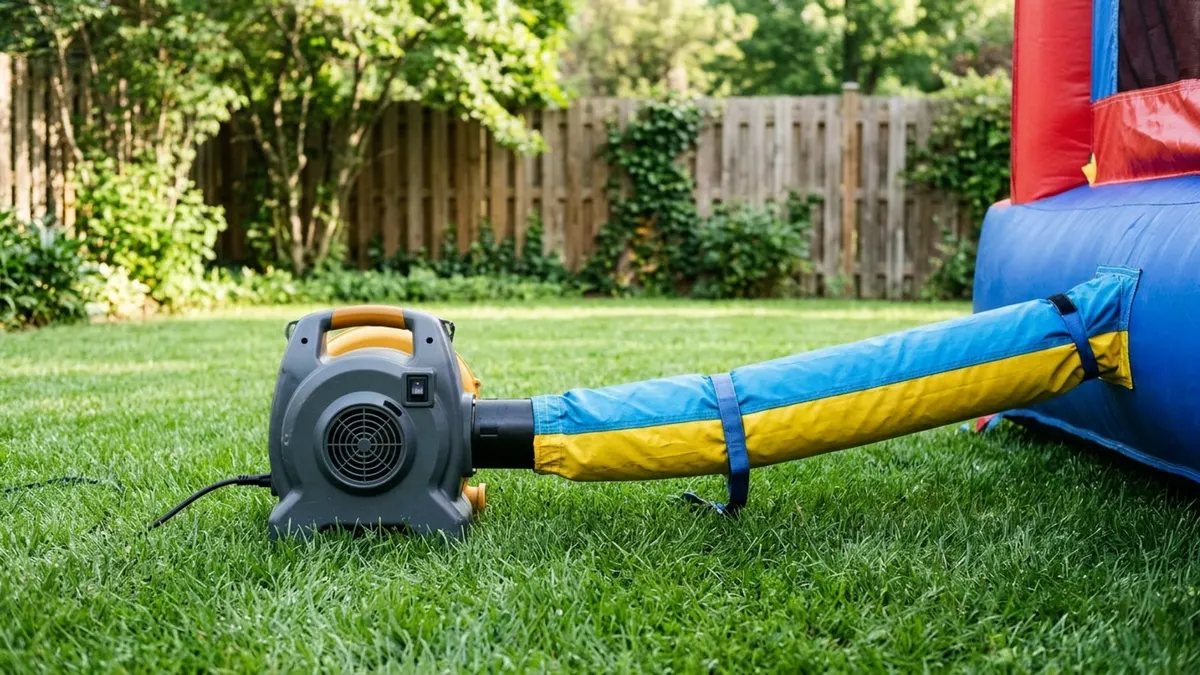
Best Bounce House Blowers: Replacement and Commercial (2026)
Five inflatable blowers from 5.5 to 11.5 amps, and why the horsepower on the box is the least useful number on it.
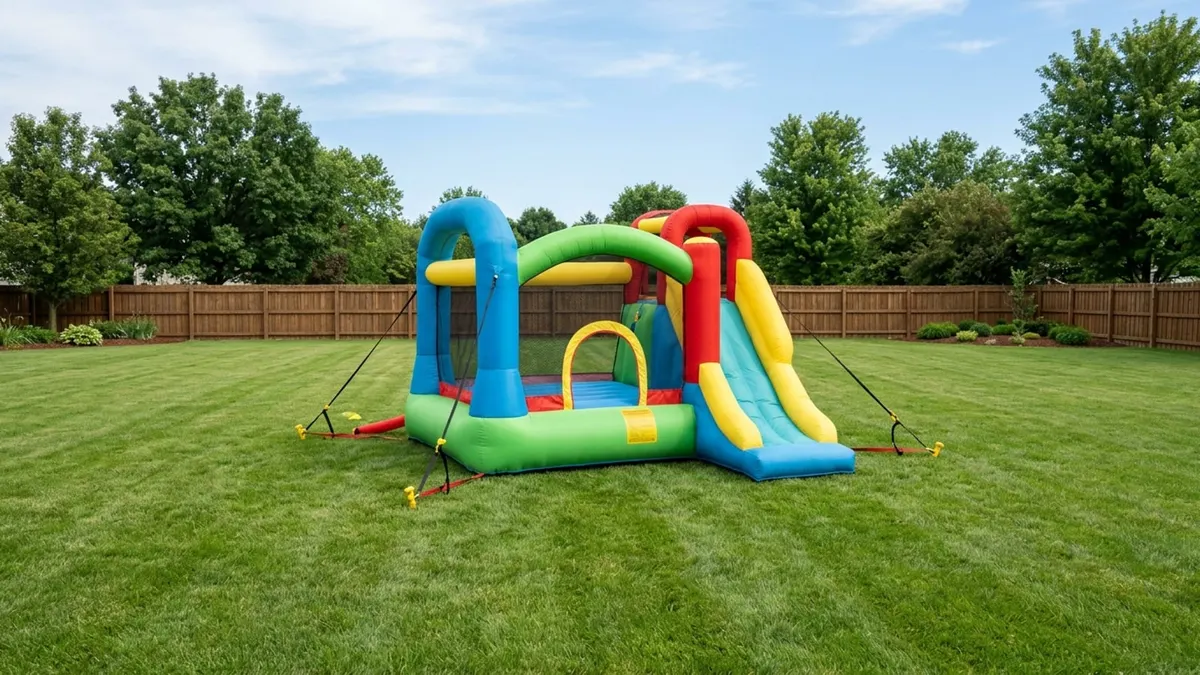
Bounce House Safety Rules: Setup, Supervision and Water
The rules every bounce house manual repeats, plus what CPSC and Nationwide Children's Hospital add, in one checklist you can print for the party.
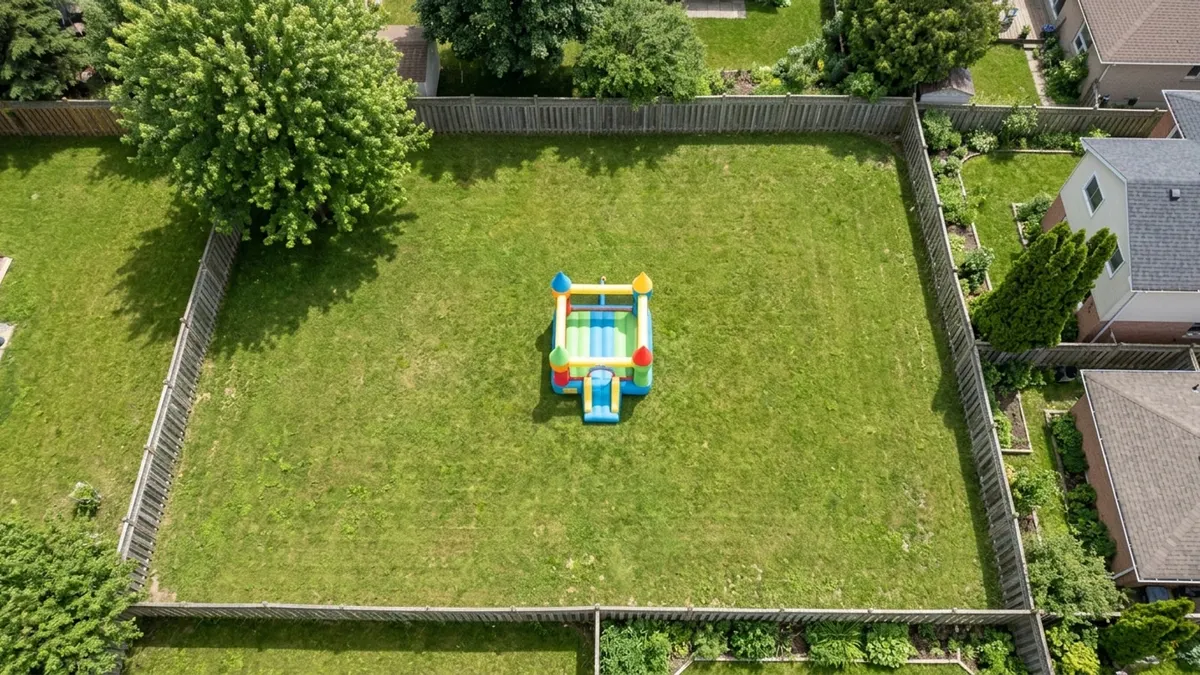
Bounce House Size Calculator: Will It Fit Your Yard?
Enter a bounce house (or pick one) and your lawn, and see the space it really needs once the makers' clearance zone is added.