
Outdoor Movie Screen Size and Projector Throw Distance Guide
How big a picture an inflatable movie screen really gives, and how far back the projector goes: 16:9 sizes, throw ratio maths and a throw distance table.
Affiliate disclosure: product links on this page go to Amazon, or to the maker's own store for brands that sell only direct. As an Amazon Associate we earn from qualifying purchases, at no extra cost to you; a link to a maker's store earns us nothing. No retailer or brand sees our picks before they are published or has any say in them. How we choose.
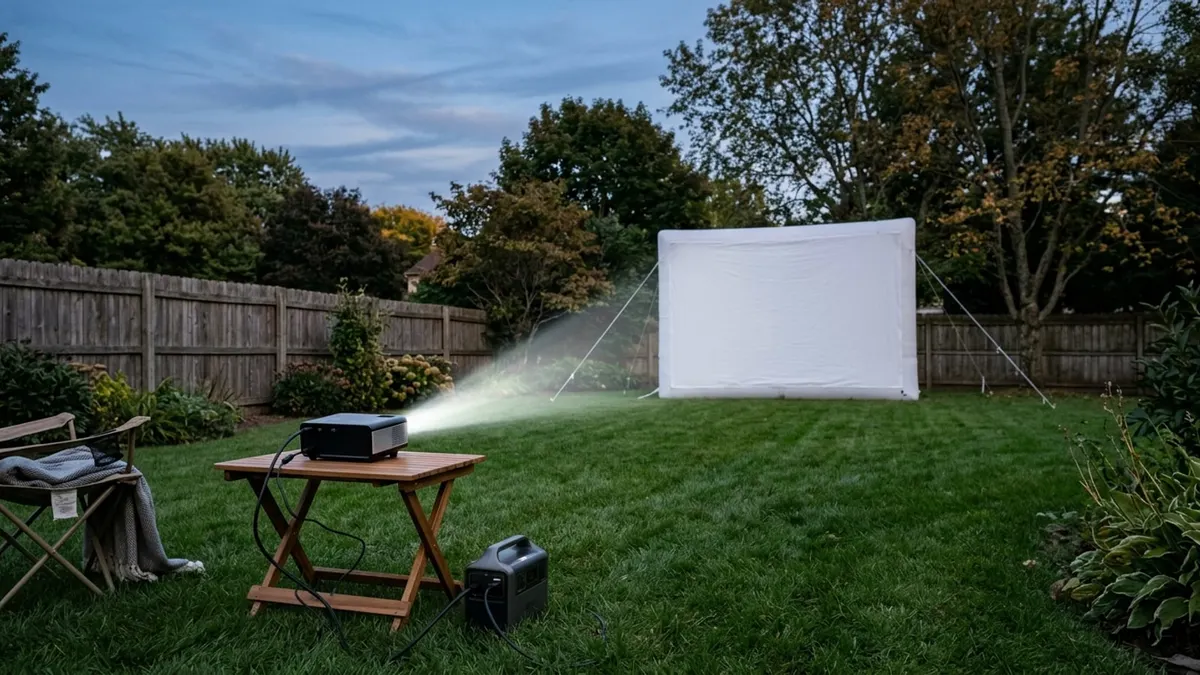
Measure the picture, not the frame, then multiply its width by your projector's throw ratio: that is how far back the projector goes. A screen sold as "20 ft" usually has a picture about 12.6 to 13.8 ft wide (XHYCPY and VEVOR's listings), so a projector with a 1.2 throw ratio sits about 15 to 17 ft from it, and one with a 2.0 ratio about 25 to 28 ft. BenQ defines throw ratio as throw distance divided by image width: a 2.0 ratio means 2 ft of distance for every foot of picture width.
Picture size: title versus reality
Inflatable screens are sold by the frame. What you watch is the white panel inside it.
| Screen | Sold as | Picture (per its listing) | Diagonal |
|---|---|---|---|
| Gemmy Deluxe Airblown | 144 in screen, 11.5 ft wide frame | 123 x 70 in | 144 in |
| XHYCPY | 20 ft | 12.6 x 7.1 ft | about 173 in |
| VEVOR | 20 ft | 13.8 x 8.2 ft | about 190 in |
| VEVOR | 24 ft | 16.4 x 9.84 ft | about 226 in |
16:9 sizes by diagonal
For a 16:9 picture, width = diagonal x 0.872 and height = diagonal x 0.490 (from the 16 by 9 triangle, whose long side is about 18.36 units).
| Diagonal | Width | Height |
|---|---|---|
| 100 in | 7.26 ft | 4.09 ft |
| 120 in | 8.72 ft | 4.90 ft |
| 144 in | 10.46 ft | 5.88 ft |
| 150 in | 10.89 ft | 6.13 ft |
| 180 in | 13.07 ft | 7.35 ft |
| 200 in | 14.53 ft | 8.17 ft |
Throw ratio: the one spec that sets the distance
Throw distance = throw ratio x picture width. You find the throw ratio on the projector's spec sheet; zoom lenses give a range. BenQ's own examples show the spread: its standard-throw TK710 fills a 100 in picture from 8.4 ft (a ratio of about 1.16), its W5800 a 150 in picture from 16.6 ft (about 1.52), and its short-throw X500i a 100 in picture from 5 ft (about 0.69).
Throw distance by picture width
| Picture width | Ratio 0.5 | Ratio 1.2 | Ratio 1.5 | Ratio 2.0 |
|---|---|---|---|---|
| 7.26 ft (100 in) | 3.6 ft | 8.7 ft | 10.9 ft | 14.5 ft |
| 10.25 ft (Gemmy 123 in wide) | 5.1 ft | 12.3 ft | 15.4 ft | 20.5 ft |
| 12.6 ft (XHYCPY 20 ft) | 6.3 ft | 15.1 ft | 18.9 ft | 25.2 ft |
| 13.8 ft (VEVOR 20 ft) | 6.9 ft | 16.6 ft | 20.7 ft | 27.6 ft |
| 16.4 ft (VEVOR 24 ft) | 8.2 ft | 19.7 ft | 24.6 ft | 32.8 ft |
Where the front row sits
Throw ratio places the projector; viewing angle places the audience. BenQ cites THX's recommended viewing angle of 36 degrees, the point at which the picture fills a comfortable share of your vision without making you turn your head. At 36 degrees the viewer sits at the picture width divided by twice the tangent of 18 degrees, which works out to about 1.54 times the picture width (our arithmetic). Closer than that feels like the front row of a cinema; much farther and a 20 ft screen starts to look like a big TV.
| Screen | Picture width | Seats at about |
|---|---|---|
| iuoni 12 ft (120 in class) | 8.7 ft | 13.4 ft |
| Gemmy Deluxe (144 in) | 10.25 ft | 15.8 ft |
| XHYCPY 20 ft | 12.6 ft | 19.4 ft |
| VEVOR 20 ft | 13.8 ft | 21.2 ft |
| VEVOR 24 ft | 16.4 ft | 25.2 ft |
With front projection the projector often ends up among or just behind those seats, which is fine as long as nobody's head is in the beam. Raise the projector on a table, or switch to rear projection.
Planning the yard
Front or rear
With front projection the projector sits in or behind the audience, and the throw distance above is measured from the screen toward the seats. With rear projection, the distance is measured behind the screen, which keeps the beam out of the crowd but needs that much clear lawn behind it. VEVOR, XHYCPY and iuoni list both; set the projector to flip the image for rear projection.
Room for the frame and the anchors
The frame is bigger than the picture and needs anchoring room: XHYCPY gives its 20 ft frame as 15.6 ft wide, 12.1 ft tall and 6.3 ft deep. Leave space for the stakes and ropes on every side, and keep the blower behind the screen, away from the audience. Skip gusty evenings: CPSC's ceiling for bounce houses, no more than 15 to 25 mph of wind, is a sensible limit for any large inflatable.
Brightness
The same projector spread over a bigger picture looks dimmer. BenQ says a good portable outdoor projector delivers at least 500 lumens, which works well at night, and that 3,000 lumens would be nice but is only available from full-size projectors. A small battery projector suits a 120 to 144 in picture; a 190 in or larger picture wants a mains-powered, brighter model. If your projector struggles indoors at 100 in, it will struggle outdoors at 190 in, so choose the screen to suit the projector.
When to press play
Backyard films start at dusk, and dusk has stages. The National Weather Service defines civil twilight as ending in the evening when the sun's center is 6 degrees below the horizon; until then, it says, artificial light is often not needed outdoors, which also means the sky is too bright for a good picture. Nautical twilight ends when the sun is 12 degrees down, by which point detailed outdoor activities need lighting. Start the film after civil twilight ends, and expect the picture to keep improving until nautical twilight ends. Your local sunset and twilight times are in any NWS or almanac listing.
Sound and blower noise
Constant-air screens keep a blower running throughout. iuoni's listing puts typical blower screens at 50 to 60 dB and sells a sealed frame to avoid it. Put speakers near the screen, and the blower on the far side of it.
Power for the screen
Constant-air screens run a small blower for the whole film: XHYCPY lists a 110 V, 250 W blower and VEVOR a 350 W one. XPOWER sells its 5.5 A BR-35 blower as suitable for movie screens up to 16 ft, per its listing. Plug the blower and the projector into a GFCI-protected outlet; CPSC's fact sheet notes the electrical code has required GFCI protection on outdoor receptacles since 1973, and that portable GFCIs exist for outlets without it. Run the cords along the edge of the lawn rather than across the seating, and keep the blower behind the screen so its noise and intake are away from the audience. Our blower guide explains amps and spare blowers.
Worked example
A VEVOR 20 ft screen (13.8 ft wide picture) and a projector rated at 1.2 to 1.5: it needs to sit 16.6 to 20.7 ft from the screen. The front row sits about 21 ft back for a 36 degree view, so the projector lands just behind the first seats. Add the 6 ft or so the frame and its anchors take up behind the screen, and a few rows of chairs, and you need a lawn roughly 35 to 45 ft long for a comfortable movie night. Our inflatable movie screen guide compares the screens; for anchoring, see anchors and sandbags.
Frequently asked questions
How do I calculate projector throw distance?
Multiply the projector's throw ratio by the picture width. BenQ defines throw ratio as distance divided by width, so a 1.2 ratio projector needs 1.2 ft of distance for every foot of picture width: about 16.6 ft for a 13.8 ft wide picture.
How big is the picture on a 20 ft inflatable screen?
Smaller than 20 ft: the number is the frame. VEVOR's 20 ft screen has a 13.8 by 8.2 ft picture and XHYCPY's 20 ft has 12.6 by 7.1 ft, per their listings.
How far should the projector be from a 16 ft screen?
It depends on the picture width and the projector's throw ratio, not the 16 ft title. Measure the white picture area, then multiply its width by the throw ratio on your projector's spec sheet.
What is a short throw projector?
One with a low throw ratio that fills a big picture from close up. BenQ's short-throw X500i fills a 100 in picture from 5 ft, a ratio of about 0.69, against about 1.16 for its standard TK710.
How wide is a 150 inch 16:9 screen?
About 10.9 ft wide and 6.1 ft tall. For 16:9, width is the diagonal x 0.872 and height is the diagonal x 0.490.
How far back should you sit from an inflatable movie screen?
BenQ cites THX's recommended viewing angle of 36 degrees. That puts the front row at about 1.54 times the picture width: about 21 ft from a VEVOR 20 ft screen's 13.8 ft wide picture, or 16 ft from Gemmy's 144 in picture.
When is it dark enough for an outdoor movie?
Wait until civil twilight ends, when the sun is 6 degrees below the horizon by the National Weather Service's definition. The picture keeps improving toward the end of nautical twilight, when the sun is 12 degrees down.
Sources
- What Is Throw Ratio for Projectors?, BenQ
- Don't Get Swept Away: CPSC Reminds Consumers to Be Grounded in Safety When Using Bounce Houses, U.S. Consumer Product Safety Commission
- The Best Seat-to-Screen Distance for Different Projector Screen Sizes, BenQ
- How Many Lumens Do You Need for an Outdoor Projector? (2025 Guide), BenQ
- Twilight Types, National Weather Service
- What Is a GFCI? (fact sheet), U.S. Consumer Product Safety Commission
Cover image: Illustration: Backyard Inflatable Review (AI-generated)
Related guides
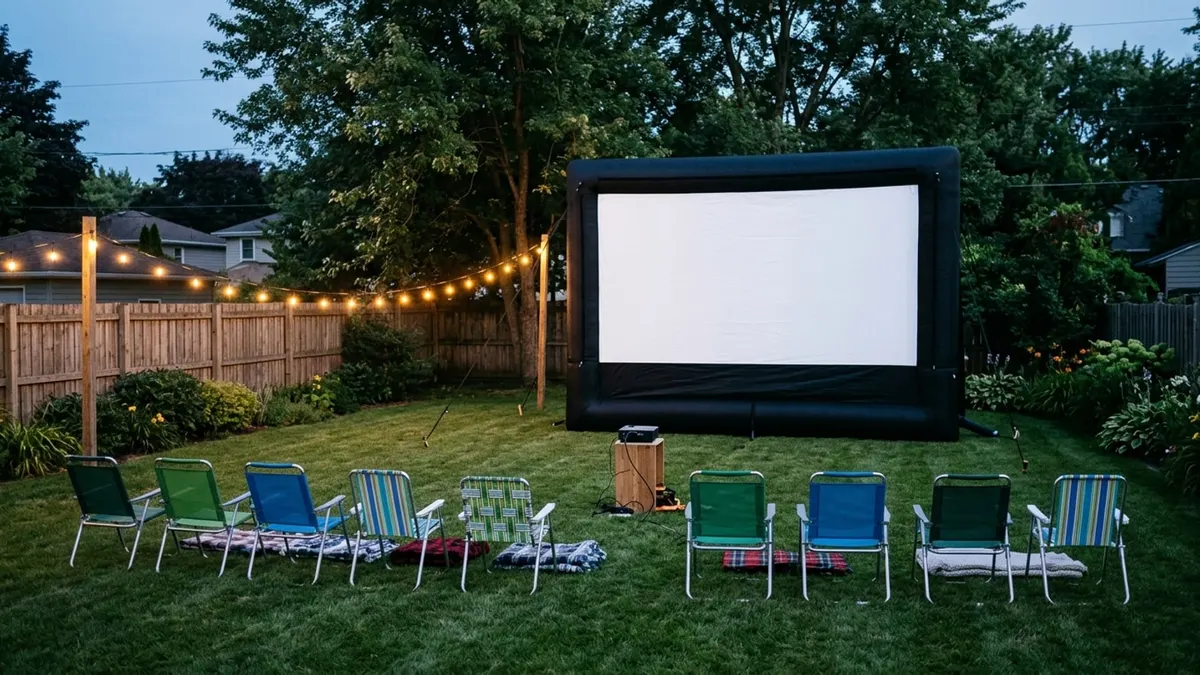
Best Inflatable Movie Screens for Backyard Movie Nights (2026)
Five blow-up projector screens from VEVOR, Gemmy, XHYCPY and iuoni, sized by the picture you actually get rather than the number in the title.
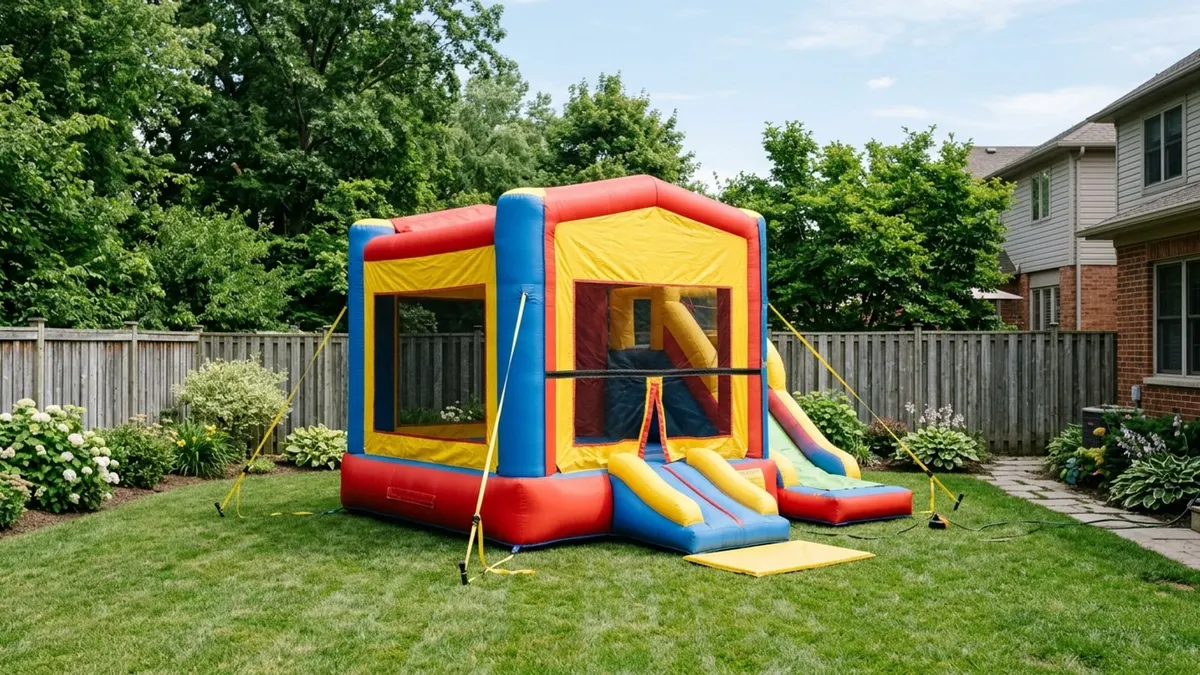
Best Bounce Houses for the Backyard (2026)
Six bounce houses compared on the numbers that decide whether one fits your kids and your yard: weight limits, kid counts, footprint and the blower.
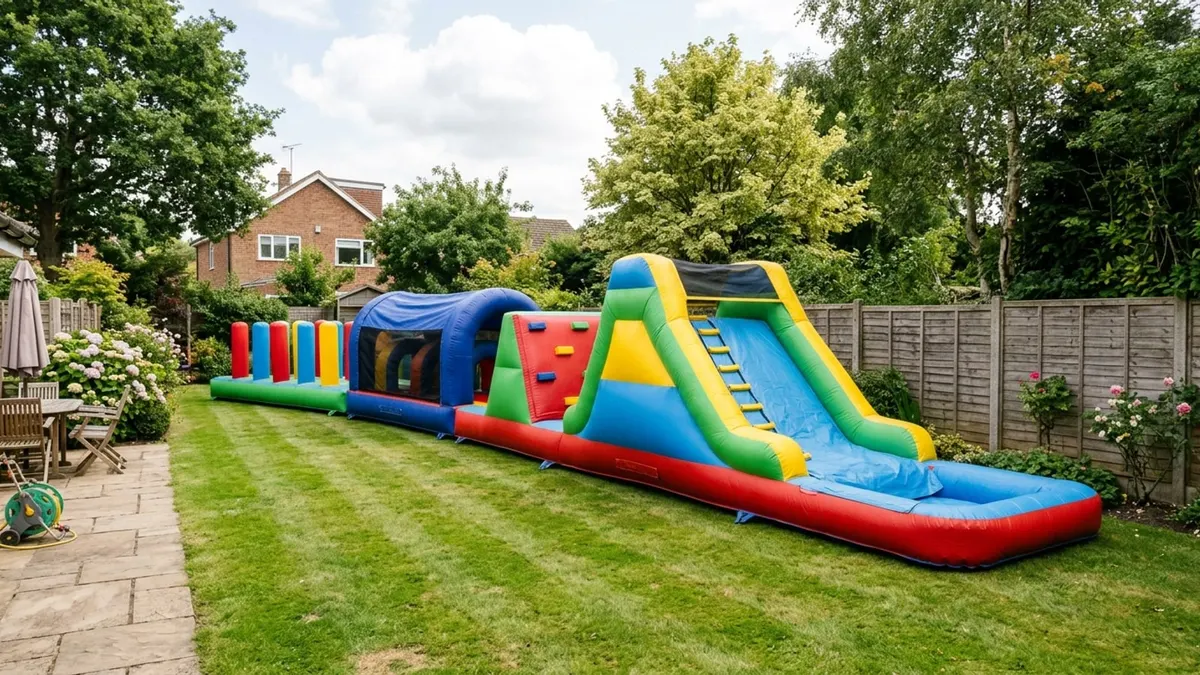
Best Inflatable Obstacle Courses for the Backyard (2026)
Five obstacle courses from 19 to 28 ft long, from Bounceland's two-lane Pro Racer to vinyl courses rated for adults.