
Inflatable Hot Tub Chemicals: Bromine vs Chlorine, Levels and Testing
Which chemicals an inflatable hot tub needs: CDC's chlorine, bromine and pH levels, how often to test and drain, bromine vs chlorine, and the starter kit to buy.
Affiliate disclosure: product links on this page go to Amazon, or to the maker's own store for brands that sell only direct. As an Amazon Associate we earn from qualifying purchases, at no extra cost to you; a link to a maker's store earns us nothing. No retailer or brand sees our picks before they are published or has any say in them. How we choose.
An inflatable hot tub needs a sanitizer kept in range, a pH kept in range, and a way to test both. CDC's targets for home hot tubs are free chlorine of at least 3 ppm and a pH of 7.0 to 7.8, tested at least twice a day; its guidance for public hot tubs allows bromine at a minimum of 4 ppm instead of chlorine. CDC also says not to use cyanuric acid, or chlorine products that contain it, in hot tubs. That last rule is why bromine is the simpler choice for most inflatable spas.
The numbers to hold
| What | Target | Source |
|---|---|---|
| Free chlorine | At least 3 ppm | CDC, home hot tubs |
| Bromine (instead of chlorine) | At least 4 ppm | CDC, public hot tubs |
| pH | 7.0 to 7.8 | CDC |
| Testing | At least twice a day, more with heavy use | CDC, home hot tubs |
| Water temperature | Never above 104°F | CDC; Intex PureSpa manual |
| Water changes | Drain and replace all or part weekly to monthly, by use | CDC, public hot tubs |
| Upper sanitizer limit | Do not exceed the maker's instructions | CDC, public hot tubs |
Bromine vs chlorine
Chlorine
Chlorine works, and CDC's home target for hot tubs is at least 3 ppm free chlorine. The catch for small tubs is the form it comes in. Many spa chlorine granules and tablets are stabilized with cyanuric acid, and CDC's home hot tub guidance says not to use cyanuric acid or chlorine products with cyanuric acid in hot tubs. Read the active ingredient on the label before you buy chlorine for a spa.
Bromine
Bromine tablets dissolve slowly from a floating dispenser, which suits an inflatable tub that sits covered most of the week. CDC's public hot tub guidance sets bromine at a minimum of 4 ppm. Test strips and DPD kits that read bromine are easy to find.
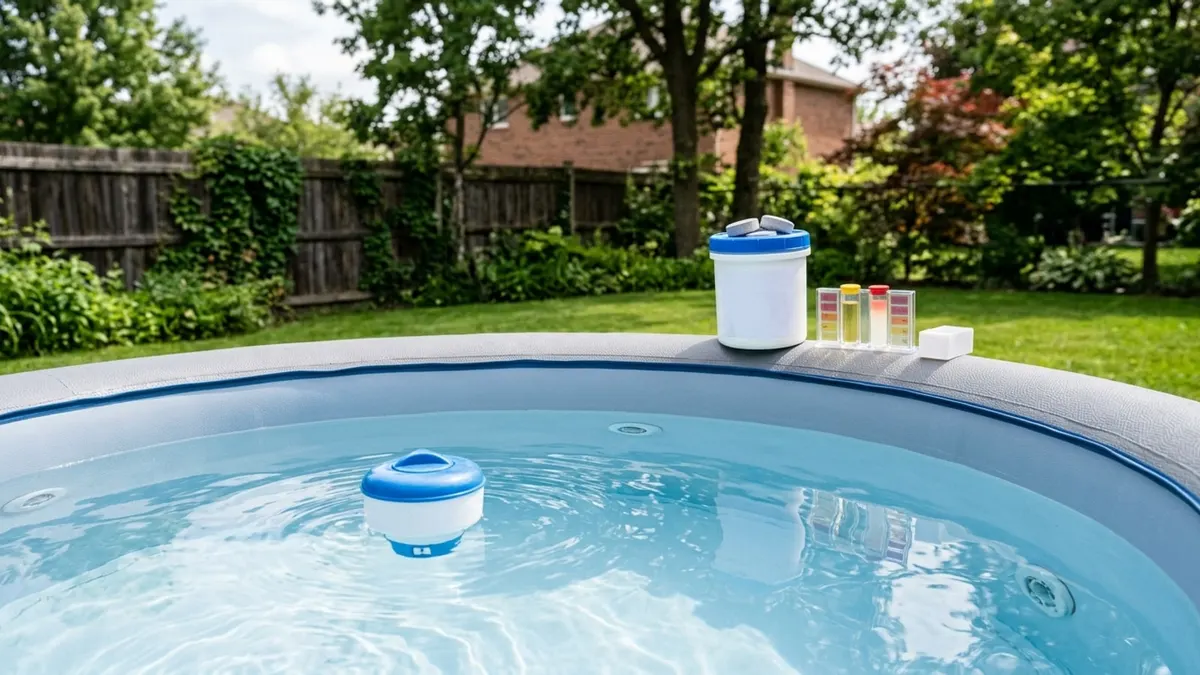
A floating dispenser holds the tablets; set its vents to keep the reading in range.
Saltwater (Intex)
Intex's PureSpa is saltwater-ready. Its manual gives an ideal salt level of 2,000 to 3,000 ppm (2,500 optimal) and says to keep free chlorine at 2 to 4 ppm while the sanitizer runs, testing weekly once the level is stable. It also notes that the sanitation system and the heater cannot run at the same time. A saltwater system makes chlorine from the salt; it still needs testing.
Testing
CDC says a DPD test kit gives the most accurate results and that test strips are less accurate; whichever you use, follow its maker's directions. A DPD kit that reads chlorine, bromine, pH and alkalinity:
Strips are quicker for the twice-daily check: Leisure Time spa test strips read chlorine and bromine.
A simple routine
- Fill and heat. Fill to the maker's line and start heating with the cover on.
- Check pH. Bring it into CDC's 7.0 to 7.8 range, following the adjuster's label.
- Add sanitizer. Bromine in a floater (to at least 4 ppm), or chlorine without cyanuric acid (to at least 3 ppm), following the product label.
- Test at least twice a day when the tub is in use, as CDC advises, and adjust.
- Drain and refill weekly to monthly depending on use, and clean or replace the filter cartridge before refilling, per CDC's public guidance.
- Keep the cover locked. Intex calls an unlocked spa a drowning risk for children.
If you would rather buy everything at once, starter kits bundle a sanitizer, balancers and test strips, such as the AquaDoc inflatable hot tub kit with bromine. Check that the sanitizer in any kit fits CDC's advice before you use it.
Why a hot tub is treated differently from a kiddie pool
CDC tells owners of inflatable kiddie pools not to add chlorine or bromine at all and to empty them daily, because splash-out makes the dose impossible to judge and there is no filter. A hot tub is the opposite case: it has a filter pump, stays filled for weeks, and runs at up to 104°F, so CDC's guidance is to keep a sanitizer at a measured level and test it twice a day. That is why the same family can be told "no chlorine" for the toddler pool and "at least 3 ppm" for the spa.
Temperature and health
Intex's PureSpa manual says the water should never exceed 104°F, that 100 to 104°F is considered safe for a healthy adult and that lower temperatures are recommended for young children. It says pregnant women, people with heart disease, high or low blood pressure, circulatory problems or diabetes, and anyone on medication should consult a physician before using a spa. CDC's public hot tub guidance also caps the water at 104°F.
What comes in the box
- Intex PureSpa: a floating chlorine dispenser, two filter cartridges and a hard-water treatment system, per Intex.
- Bestway and Coleman SaluSpa: a ChemConnect dispenser, per their listings.
Neither replaces testing. Whatever sanitizer you use, the reading is what counts.
Common mistakes
- Using pool tablets. Pool trichlor tablets contain cyanuric acid; CDC advises against cyanuric acid in hot tubs.
- Skipping tests between uses. CDC says at least twice a day when in use.
- Topping up instead of draining. Partial or full water changes on a weekly to monthly schedule keep the water manageable.
- Running hotter than 104°F. Intex and CDC both cap it there.
For running costs, see the hot tub cost calculator; to choose a tub, see best inflatable hot tubs.
Frequently asked questions
What chemicals do I need for an inflatable hot tub?
A sanitizer (bromine, or chlorine without cyanuric acid), pH adjusters, and a test kit. CDC's targets are free chlorine of at least 3 ppm or bromine of at least 4 ppm, with pH 7.0 to 7.8.
Is bromine or chlorine better for an inflatable hot tub?
Bromine is simpler for most: it dissolves slowly from a floater, and CDC advises against cyanuric acid and stabilized chlorine products in hot tubs, which rules out many common chlorine granules and tablets. Unstabilized chlorine also works at 3 ppm or more.
How often should I test my hot tub water?
CDC says at least twice a day for home hot tubs, and more often when many people use it. A DPD kit is the most accurate; strips are quicker but less accurate.
How often should you change inflatable hot tub water?
CDC's guidance for public hot tubs is to drain and replace all or portions of the water weekly to monthly, depending on usage and water quality, and to clean or replace the filter before refilling.
Can I use pool chlorine tablets in my hot tub?
Most pool tablets are trichlor, which contains cyanuric acid, and CDC says not to use cyanuric acid or chlorine products containing it in hot tubs. Use bromine or an unstabilized chlorine made for spas.
What pH should a hot tub be?
7.0 to 7.8, per CDC's guidance for both pools and hot tubs. Test it along with the sanitizer at least twice a day when the tub is in use, and adjust it with a pH increaser or reducer following the label.
Sources
- Home Pool and Hot Tub Water Treatment and Testing, Centers for Disease Control and Prevention
- Operating and Managing Public Pools, Hot Tubs and Splash Pads, Centers for Disease Control and Prevention
- PureSpa Sahara Tan Round Bubble Spa Owner's Manual (380PO), Intex
- PureSpa Sahara Tan Round Bubble Inflatable Spa Set, 6-Person, Intex
Cover image: Illustration: Backyard Inflatable Review (AI-generated)
Related guides
Best Inflatable Hot Tubs (2026)
Five plug-in inflatable hot tubs from Intex, Bestway, Coleman and MSpa, with the heater, heating rate and cold-weather rule that separate them.
Best Inflatable Hot Tubs for Winter and Cold Weather (2026)
Inflatable hot tubs sold to stay up all year, the freeze features that make that possible, and the popular tub whose maker says to pack it away.
Inflatable Hot Tub Running Cost Calculator
Heat-up energy and time from the physics, monthly cost from your heater hours and your electricity price, with Intex PureSpa presets from its manual.